What began as a routine archaeological survey before road construction near Aarhus, Denmark, turned into something much larger. Excavation teams kept finding more pit houses, textile production features, and evidence of organized activity spreading across the landscape. After ten months of digging, beginning in August 2025, they had uncovered one of the most extensive Viking Age production sites found in Denmark.
The site at Søften, about six miles north of Aarhus, covers about 1.08 million square feet (about 100,000 square meters) and dates to between roughly A.D. 600 and 950, according to the AP. Archaeologists from the Moesgaard Museum have identified 82 pit houses, a dedicated area for processing flax, and a range of artifacts, including spindle whorls, loom weights, silver coins, glass beads, and pottery, all pointing to a textile operation that was organized, sustained, and working on a serious scale.
"We do not see traces of an ordinary village, but of a production area that has been specialized and organized on a large scale. The settlement appears with separate areas for production, crafts, and a single residential house. The structure suggests that the activities have been led by a central actor with control over resources and production," said excavation leader Liv Stidsing Reher-Langberg in a translated press release.

 Explore All Options
A Viking Textile Site Emerges in Denmark

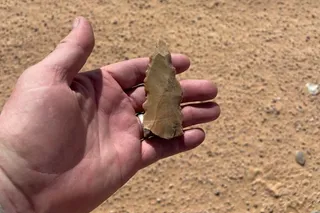
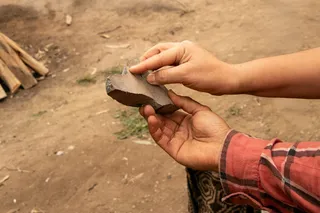
Knives found at the site
(Image Courtesy of Moesgaard)
Unlike a typical Viking village, the site is organized into distinct functional zones, production areas, craft areas, and a single dwelling. The presence of a lone residential structure alongside so many workshops suggests someone was running the show, directing the work rather than a community of households each producing for themselves.
Metal detector hobbyists had been finding silver coins in the area for roughly three decades before the excavations began, according to the AP. A trial dig about eighteen months ago, prompted by plans for a new road and industrial development, revealed pit house after pit house extending beyond the initial survey area.
The current dig covers over 645,834 square feet (about 60,000 square meters). Combined with earlier investigations at the same site in 2008 and 2013, which uncovered a further 34 pit houses, the full settlement is estimated to have stretched across at least 1.08 million square feet (about 100,000 square meters), making it one of the largest Viking production sites ever found in the region.
How Søften May Have Supplied Viking Trade

Beads
(Image Courtesy of Moesgaard)
The Søften site sits about four kilometers from Lisbjerg, where earlier excavations revealed a high-status Viking settlement with close connections to the royal trading city of Aros, the Viking name for what is now Aarhus.
“In the Viking Age, Aarhus emerged as one of the kingdom's most important trading [centers] under the king. But Viking Age cities did not arise alone, and Søften and Lisbjerg are very clear examples of this. Goods and resources were brought from the surrounding countryside, which were traded in the cities and thus entered the extensive international network of the Viking Age,” said historian Kasper H. Andersen in the press release.
Textiles were among the most valuable trade goods of the Viking Age, and a facility of this size would have been supplying markets well beyond Aarhus. Future carbon dating and pollen analysis may eventually answer what exactly was being made there and for how long, according to the AP.
The excavation is expected to wrap up by the end of June 2026.
Read More: No, Vikings Didn’t Have Horns On Their Helmets — Here’s The True Origins of the Myth
Article Sources
Our writers at Discovermagazine.com use peer-reviewed studies and high-quality sources for our articles, and our editors review for scientific accuracy and editorial standards. Review the sources used below for this article:
- This article references information from Moesgaard: Moesgaard finds large production site from the Viking Age north of Aarhus
- This article references information from the AP: Archaeologists find huge Viking textile production site in Denmark