

Seven hundred thousand years ago, an elephant was trekking through the woodlands and wetlands of the Upper Jordan River in modern-day Israel. Today, its remains serve as a biological time capsule, offering a window into Pleistocene ecosystems and the lives of the communities that lived there.
A team of researchers led by Hannah Farrell, a Ph.D. candidate at Haifa University, has pieced together information about the habitat using clues contained within molars and tusk fragments of a straight-tusked elephant (Palaeoloxodon antiquus).
The results suggest that the region would have been covered in woodlands, wetlands, and waterways. This lush environment would have provided refuge for animals and humans traversing the Levantine Corridor, a land bridge that provided the only throughfare between Africa and Eurasia, researchers writing in Quaternary Science Reviews said.
Farrell told Discover that the discovery of a molar with its structure so well preserved was an exciting finding in and of itself.
“With it, we were able to establish a rare, detailed look at the ecosystem over a span of a few years of this elephant's life 700,000 years ago,” Farrell said.
“Our findings indicate that during the Middle Pleistocene (about 700,000 years ago), the Levantine Corridor had a humid, stable Mediterranean climate and that the landscape was a mosaic of wetlands and relatively open oak woodlands, with grasses and riparian vegetation,” Farrell added.

 Explore All Options
Read More: Neanderthals Hunted Straight-Tusked Elephants as They Traveled Across Europe 125,000 Years Ago
A Mediterranean-Like Climate
Straight-tusked elephants, which had originated in Africa but spread to Eurasia, were one of the largest terrestrial mammals of the Middle to Late Pleistocene.

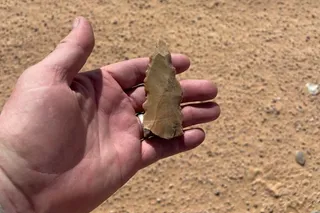
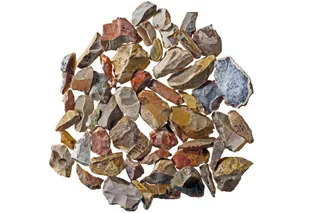
Basalt handaxes found near the remains
(Image Credit: Tel-Hai University of Kiryat Shmona in the Galilee and Hannah Farrell, University of Haifa)
Researchers found remains of one individual at North of Bridge Acheulian, a site south of the Hula Valley in northern Israel, alongside basalt handaxes and cleavers attributed to an as-yet-unidentified group of hominins known for producing Acheulian tools and preferring large mammals.
Using a range of techniques, from CT scanning to microscopic wear analysis, which studies abrasion patterns on the tooth, the team determined the environment the elephant and the hominins inhabited.
Carbon and oxygen isotope analysis showed the elephant regularly ingested well-watered vegetation, suggesting the region received plenty of water. Meanwhile, pollen analysis contained evidence of Mediterranean trees and open grassland, as well as reeds, willow, tamarisk, and other vegetation common to wetlands.
Taken together, this paints a picture of a humid Mediterranean climate, oak woodlands, and a relatively open landscape. The researchers say the combination of water and vegetation likely provided humans, straight-tusked elephants, and other species with a reliable supply of water and food.
Dominant Ecosystem Engineers

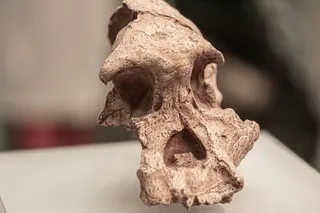
Fossilized tusk fragments.
(Image Credit: Tel-Hai University of Kiryat Shmona in the Galilee and Hannah Farrell, University of Haifa)
These findings echo the results of regional models that show the Levant experienced climatic fluctuations during the Pleistocene, switching between more temperate and more arid periods, which both helped and hindered the movement of hominins out of Africa. In contrast to the regions that surrounded it, the Hula Valley appears to have been a relatively stable freshwater habitat.
Remains of P. antiquus found elsewhere show the ancient elephant ancestor had a sustained presence in the Levant. The researchers say these animals were not passive background characters, but “shapers of local ecosystems” and “dominant ecosystem engineers,” who aggressively felled trees, stripped back bark, and trampled undergrowth.
For the hominins who foraged and hunted in the Levant, P. antiquus would have helped maintain access to waterways by treading across reed beds and enriching vegetation through their dung, as well as being a source of food themselves.
Farrell and Gonen Sharon, a professor at Tel-Hai University of Kiryat Shmona in the Galilee and a study co-author, told Discover that the study is part of ongoing research that aims to reconstruct the life and environment of the Acheulian people at a milestone on the road from Africa to Eurasia.
Read More: This Elephant Lived in Europe for 700,000 Years — Could It Live There Today?
Article Sources
Our writers at Discovermagazine.com use peer-reviewed studies and high-quality sources for our articles, and our editors review for scientific accuracy and editorial standards. Review the sources used below for this article:
- This article references information from a study published in Quaternary Science Reviews: Elephant dental remains from the Acheulian site at North Bridge Acheulian–Gesher Benot Ya'aqov: hominin behavior and environmental implications