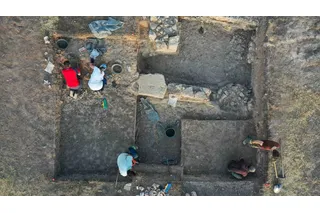
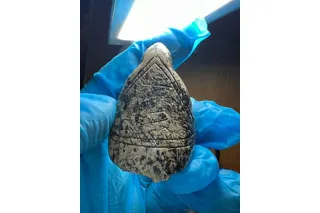
Archaeologists were tidying up their excavation near Żórawina in southwestern Poland at the end of the season when they noticed a circle in the soil. Roughly 13 feet (4 meters) across, it looked like the remains of a burial mound.
Inside its central chamber, they found 42 teeth, each with a hole drilled through its root. The cord that once joined them had disappeared, but their arrangement was still recognizable as a necklace. As the team dug deeper, a man’s almost complete skeleton emerged beneath them.
Buried with him were a stone battle axe and skull fragments from two other adults who may have been decapitated. Based on the axe’s shape, the team estimates that he was buried around 2900 B.C.E., thousands of years before the cemetery’s other known graves.
“It was clear at first glance that this was no accident,” said Paweł Dąbrowski, an anthropologist and anatomist at Wrocław Medical University, describing the necklace in a translated press release.
Inside the 5,000-Year-Old Grave in Poland
The site, outside Wrocław, was already known for burials about 1,600 years old, from the end of the Roman period and the beginning of the Migration Period. The University of Wrocław team, led by archaeologist Tomasz Gralak, also recovered amber beads, bone discs, and a flint blade from the much older grave.

 Explore All Options
The axe beneath the man’s right elbow was made from serpentinite, a metamorphic rock. Its chipped edge shows that it had been used, possibly for hunting or fighting, Dąbrowski said.
Gralak and Dąbrowski think the man may have been a hunter, warrior, or head of a family. The large necklace might have reflected his importance to the community.
Dąbrowski suspects the necklace includes teeth from members of the dog family, bears, and hoofed mammals, based on their appearance. He also raised the possibility of human teeth.
Read More: A Mummified Dog and Stacked Bodies Reveal a Crowded Egyptian Tomb’s Hidden Order
Why Were Two Other Skulls in His Grave?
Researchers also want to understand why parts of two other adults’ skulls were buried with the man. One possibility is that their heads were cut off and placed in the grave as offerings.
To test that idea, Dąbrowski will look for cuts or other damage that a sharp tool could have left on the bones. Radiocarbon dating will help the team check whether all three people lived at roughly the same time. DNA could reveal whether they were relatives and where their ancestors came from, as well as help figure out their biological sex.
Following the Clues in Their Teeth
The man’s teeth could help show whether he grew up near the place where he was buried or came from somewhere else. Teeth retain chemical traces of the environments in which they form, so by comparing the proportions of different forms of strontium with patterns in different regions, researchers hope to narrow down where both the buried people and the animals represented in the necklace lived. Wear on his teeth could also help the team work out what he ate and how his food was prepared.
Another team recently found a similar burial mound at nearby Iwiny. The two discoveries may be connected to the Corded Ware culture, a prehistoric culture in northern and central Europe named for the practice of pressing twisted cord into clay to decorate pottery. Comparing them could help researchers test whether these communities reached Lower Silesia from eastern Europe or areas around the Caspian Sea.
Dąbrowski will examine the man’s bones for signs of injuries, illness, and physical strain. Some bones were too fragile to lift out on their own, so the team removed them with the surrounding earth. X-rays will show where the fragments lie before researchers begin uncovering them.
The tests may show where the man grew up and how he lived, even if they never explain why someone chose to leave him with a necklace of 42 teeth.
Read More: Bones Buried in Italian Necropolis Offer Clues on Ancient Diets and Society Before the Romans
Article Sources
Our writers at Discovermagazine.com use peer-reviewed studies and high-quality sources for our articles, and our editors review for scientific accuracy and editorial standards. Review the sources used below for this article:
- This article references information from Wrocław Medical University: An unusual 5,000-year-old grave