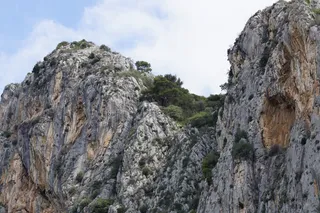


Oued Beht is an archaeological site perched between Morocco’s coast and the Atlas Mountains. Today, the area is a rural landscape filled with rolling hills, plains, and river valleys. Four thousand years ago, the area was a bustling hub, home to a community that was attending to crops, rearing livestock, and producing pottery.
Now, archaeologists involved with the Oued Beht Archaeological Project reveal the existence of a ditch-and-rampart defense structure, which radiocarbon dating shows to be more than 3,500 years old.
“It is the oldest defensive structure so far identified in North Africa beyond the Nile Valley,” first author Giulio Lucarini, at the National Research Council of Italy (CNR) and the International Association for Mediterranean and Eastern Studies (ISMEO) in Italy, told Discover.
“A structure like this is both protection and a statement of power. It suggests that social organization was becoming more formal, perhaps with emerging forms of leadership able to mobilize people for such works.”
The find has been described in a paper published in the journal Libyan Studies, along with the results of the third archaeological season, which took place in 2023.
Read More: Charred 2,000-Year-Old Wall Found Beneath Paris May Reveal the Location of Ancient Lutetia

 Explore All Options
Northern Africa’s Oldest Defense Structure
In the study, the researchers describe a defense structure comprised of a multi-phase ditch, a rampart, and a wall, which exploited the natural topography of the ridge and blocked access to the southern section of the site.
This shows us this was an organized society, said Lucarini, who co-directs the project along with Youssef Bokbot at the Institut National des Sciences de l'Archéologie et du Patrimoine (INSAP) in Morocco and Cyprian Broodbank at the University of Cambridge in the U.K.
“Digging a large ditch and piling up a rampart across the ridge took planning, coordination and a lot of labor sustained over time,” Lucarini explained. “That means a community capable of collective projects on a scale we have not documented before in northwest Africa.”
By radiocarbon dating seed and charcoal deposits, the team was able to determine when the structure was built. The results suggest it was constructed approximately 3,500 to 4,000 years ago, coinciding with the western Mediterranean’s Bronze Age.
It is not yet clear what the structure was supposed to defend the community from. However, it is thought to be linked to increasing levels of competition in terms of land and resources. It may also have been tied to a desire to control movement and maintain a strategic position in the region.
Adding another layer of intrigue, the team discovered the structure was rebuilt sometime between the 11th and 13th centuries C.E., along with a hamlet or farm and a cemetery.
Life in Oued Beht
Oued Beht was originally a Neolithic settlement, which estimates suggest was founded as early as the mid-fourth to the early third millennium B.C.E., some 5,400 to 4,900 years ago.
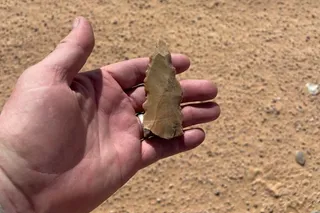
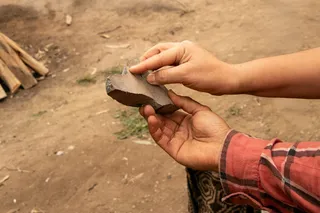
Archaeological evidence shows it grew into an agricultural hub, where local populations cultivated crops such as wheat, peas, and barley; gathered wild plants like olives and pistachios; and tended livestock such as sheep, goats, and pigs. Fragments of painted pottery and tools, including thousands of polished stone axes, suggest the site also produced crafts.
While it is not yet known if the site was a permanent settlement, a seasonal camp, or something else entirely, the changes at Oued Beht show that it was “a place that communities chose again and again over millennia,” said Lucarini.
Links Between Oued Beht and Iberia
There is also evidence of a connection with Iberia, where fragments of ivory, ostrich eggshell, and painted pottery show ties to Africa. Deep storage pits found at Oued Beht display strong similarities with those found in southern Europe, again hinting at links between the two regions.
The team says the site sheds more light on the role of the Maghreb — a region in northwest Africa that includes modern-day Morocco, Algeria, Tunisia, Libya, and Mauritania.
— at this point in prehistory.
“For more than a century, the Maghreb between about 4000 and 1000 B.C.E. was a blank on the map of Mediterranean prehistory,” said Lucarini.
“Meanwhile, other regions saw spectacular developments: the fortified megasites of Copper Age Iberia, or the Predynastic and Early Dynastic [centers] of Egypt. Oued Beht shows that this gap was due to a lack of research, not a lack of evidence,” Lucarini concluded.
Read More: Prehistoric Underwater Wall Hints at Sophisticated Human Engineering 7,000 Years Ago
Article Sources
Our writers at Discovermagazine.com use peer-reviewed studies and high-quality sources for our articles, and our editors review for scientific accuracy and editorial standards. Review the sources used below for this article:
- This article references information from a study published in Libyan Studies: Expanding Oued Beht: Final Neolithic, Bronze Age, medieval and later discoveries from excavation and survey in 2023