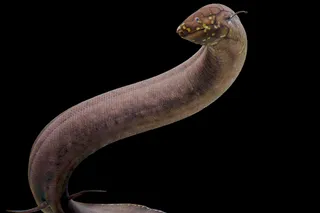
A gossamer worm moves through the water faster than its body shape should allow. Nearby, single-celled organisms drift past, large enough to see with the naked eye. Eight hundred meters down, an octopus wraps itself around a bright red jellyfish and feeds. Researchers captured these scenes off Brazil, in the ocean’s midwater, a layer between sunlight and seafloor where many gelatinous-bodied animals are easier to film alive than to bring to the surface.
Over two weeks in the tropical South Atlantic, researchers aboard Schmidt Ocean Institute's Falkor (too) confirmed 31 new species by combining high-resolution imaging, onboard genetic sequencing, and a microscope known as Squid, which allowed scientists to observe living 3D cellular structures at sea for the first time onboard a ship. These tools helped study fragile animals before traditional collection methods could damage them, and turned identifications that often take years into confirmations made within days.
“The largest habitat on Earth, the midwater, is filled with incredible animals we are only just starting to understand,” said Karen Osborn, the expedition’s chief scientist, in a press release. “I continue to be fascinated by the fantastic variety of solutions they have evolved to survive in this formidable environment, and that drives me to keep asking questions about our ocean.”

 Explore All Options
Read More: Carnivorous Death-Ball Sponge and Other New Species Have Been Found in the Deep Sea
Discovering New Species in the Ocean’s Midwater off Brazil

juvenile glass squid
(Image Courtesy of Emily Clark / MBARI via Schmidt Ocean Institute)
The midwater makes up the largest living space on Earth but remains one of the least studied. Its volume makes it difficult to survey systematically, and because so many of its inhabitants never survive the journey to the surface, researchers have had only glimpses of what lives there. The midwater also plays a central role in how carbon moves through the ocean, a process that affects the entire planet.
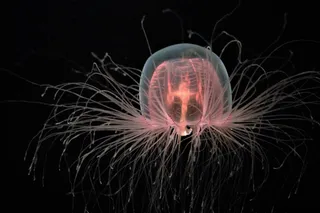
The new species confirmed include nine jellyfish, seven siphonophores, colonial organisms related to the venomous Portuguese Man-o-war, seven comb jellies, four larvaceans — tadpole-like creatures more closely related to humans than to most invertebrates — two giant rhizarians, single-celled organisms large enough to see with the naked eye, one amphipod related to crabs and lobsters, and the gossamer worm.
Studying Fragile Deep-Sea Animals Without Touching Them
Because so many midwater animals fall apart during collection, the expedition relied on tools designed to study them in situ. Two instruments that use lasers to produce 3D images of animals without touching them were attached to SuBastian, the expedition's underwater robot. A shadowgraph camera was also attached to pick up finer internal details that the laser systems missed.

Crossota Millsii Jelly Fish
(Image Courtesy of Emily Clark / MBARI via Schmidt Ocean Institute)
Back on the research vessel, animals were placed in a virtual reality chamber that recreates the pressure, temperature, and light conditions of the deep sea, allowing researchers to observe natural behavior that would otherwise be impossible to study at the surface.
Two Stanford University microscopes added another dimension. One, known as the gravity machine, functions like a hydrodynamic treadmill for studying how microbes move and interact with their environment. The other, known as Squid, is an open-source confocal microscope that allowed the team to image living internal cellular structures in 3D for the first time ever aboard a ship.
“This opens a new door for researching deep-sea physiology, linking cellular architectures to organism function. We can now witness live internal processes within these extreme organisms adapted to withstand immense pressure and darkness,” said Manu Prakash of Stanford University in the press release.
Confirming New Species in Days, Not Decades

Octopus eating a jellyfish
(Image Courtesy of ROV SuBastian / Schmidt Ocean Institute)
The expedition was the third time this team has taken the midwater equipment to sea, and each trip has expanded what the technology can do. The 31 species confirmed in two weeks represent what is now possible. How many more are waiting in the midwater is a question these tools are only beginning to answer.
“The novel suite of technologies on this cruise is a glimpse into the future of marine biological science,” said Schmidt Ocean Institute’s executive director, Jyotika Virmani, in the press release. “We look forward to a future in which scientists study marine life as elegantly as this team did — and in virtual reality.”
Read More: Rare Giant Phantom Jellyfish and a Well-Preserved Whale Skeleton Spotted Off the Coast of Argentina
Article Sources
Our writers at Discovermagazine.com use peer-reviewed studies and high-quality sources for our articles, and our editors review for scientific accuracy and editorial standards. Review the sources used below for this article:
- This article includes information from Schmidt Ocean Institute: 31 New Species Discovered in Two Weeks of Deep Sea Exploration