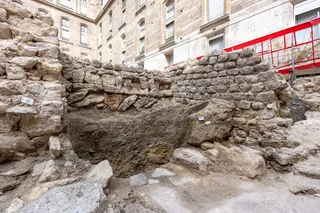


The French city of Nîmes gets its name from an ancient Celtic water deity: Nemausus. While the word has been shortened and modified over the centuries, it is perhaps fitting that archaeologists are now turning to ancient water systems to shed light on the city’s history.
By analyzing carbon deposits in Nîmes’ Roman aqueduct, researchers have shown that the system was likely expanded during the first century A.D., possibly in response to challenging climatic conditions, and ceased operation entirely by the middle of the third century A.D. — potentially as a result of a sharp drop in population linked to the Plague of Cyprian.
“The carbonate deposits document human interventions spanning roughly 300 years during the Pax Romana and [offer] insights into social unrest,” Gül Sürmelihindi of the Johannes Gutenberg University Mainz (JGU), Germany, said in a statement.
The research has been published in the journal Geoarchaeology.
Read More: 120 Ancient Inscriptions Suggest Roman Women Gathered Deep Underground to Worship 'the Lady'
Analyzing Carbon Deposits in an Ancient Aqueduct
Written records can be patchy, particularly during periods of political and social unrest. In such instances, archaeologists and historians rely on physical sources.
Here, the researchers studied carbon deposits in the city’s 31-mile (50-kilometer) long aqueduct. This enabled the team to deduce how its function may have changed in the 360 years after its construction circa 50 A.D. — and, in turn, speculate on the fate of the people of Nîmes (or, as it was known then, Nemausus).

 Explore All Options
To do so, Sürmelihindi and colleagues collected carbonate cores from ten parts of the aqueduct. They then split them in two: half were cut into thin sections for transmitted-light microscopy, and half underwent stable oxygen and carbon isotope analyses.
The cores displayed distinct patterns, not unlike tree rings, due to variations in both temperature and the flow of water, revealing changes in the use and management of the aqueduct over time.
Tracking The Rise And Decline of Nîmes
Nîmes became a Roman colony in 42 B.C.E. and initially thrived under its new rulers. They erected temples, built an amphitheater, and constructed a large aqueduct to transport water from a nearby spring to the city for drinking and bathing.
Initial modifications to the aqueduct appear to support this image of a prosperous city. Changes in the carbonate 11 years after installation suggest a new water source was introduced. The researchers believe the modifications may have resulted from a dry spell, with the sample's composition suggesting a period of low rainfall in the years prior.
The next major shift occurred around 150 A.D. The team noted that deposited carbonate layers become substantially thinner, suggesting water levels fell significantly.
This may have been the result of leakage caused by ground movement — the city lies on the Nîmes Fault Zone — but the researchers suggest a more likely explanation is that water was intentionally diverted. According to Sürmelihindi, as much as half of the water was used to irrigate the surrounding fields. However, it did not appear to have had a significantly detrimental effect on the city.
What Happened to the Population of Nîmes?
By the mid-third century, the state of the aqueduct appeared to have deteriorated. The carbonate is more porous and contains clay and sand, suggesting a decline in water quality and perhaps the city itself.
"Great economic and political turmoil prevailed across many parts of the Roman Empire,” explained Sürmelihindi. “The carbonate deposits reveal that the city's condition was deteriorating.”
By approximately 270 A.D., water supply to Nîmes appears to have stopped entirely. The team reports carbonate deposition in samples collected near the city ends at this point, while carbonate deposition from samples further away continues, suggesting use of the aqueduct persisted among rural estate owners.
"The results suggest that something happened to the population of Nîmes," said Sürmelihindi.
What could that have been? For now, explanations remain conjecture, but Sürmelihindi points to a devastating pandemic that struck the Roman Empire during the third century.
"It is possible that the Plague of Cyprian — which is primarily documented in North Africa and even in Rome, where it claimed many lives — also posed a problem in southern France,” Sürmelihindi added.
Read More: A Marble Slab at Hadrian’s Villa Records a Lightning Strike Romans Believed Came From a God
Article Sources
Our writers at Discovermagazine.com use peer-reviewed studies and high-quality sources for our articles, and our editors review for scientific accuracy and editorial standards. Review the sources used below for this article:
- This article references information from a study published in Geoarchaeology: The Usage History of the Aqueduct of Nîmes Reconstructed From Carbonate Archives: Operation, Modifications and Late Antique Breakdown and Change