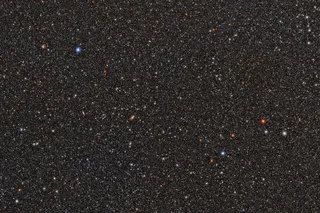


Kevin Burdge, a professor of physics at MIT, was sifting through data at the Zwicky Transient Facility, checking for supernova signals, when he noticed something odd.
The brightening and subsequent fading of a supernova typically produces a signal shaped like a bell curve. But the pattern Burdge observed was triangular, and it repeated.
“I remember first looking at this and thinking: Stars don’t make triangular waveforms like this,” Burdge said in a statement.
At first, Burdge thought it could be a black widow binary. That is, a system in which a spinning neutron star (or pulsar) consumes a less dense companion star. But in a black widow, the smaller star orbits the larger star, creating a clearly wobbling signal, and that wasn’t what was happening here.
“It didn’t make any sense,” said Burdge. “We couldn’t explain what this was.”
That was several years ago. Now, in a paper published in Nature Astronomy, Burdge and colleagues describe what is causing this mysterious signal: a red dwarf slowly cannibalizing a brown dwarf. Researchers say this is the first time astronomers have observed a low-mass object slowly swallowing a second low-mass object rather than devouring it.
“When we think of stars interacting with planets or brown dwarfs, the picture is always that the star eventually swallows the other thing,” said Burdge. “This is what will happen to the Earth when the sun becomes a red giant. But here, we’ve found an alternative: Instead of swallowing the thing up, the star can gradually eat it, for billions of years.”

 Explore All Options
Read More: A Failed Star can Form Brown Dwarf Stars, Which Host Their Own Planetary Systems
A Brown Dwarf Circling A Red Dwarf
Burdge published the paper after taking another look at the data with Aaron Householder, a graduate student in MIT’s Department of Earth, Atmospheric and Planetary Sciences.
Burdge and Householder located the source of the signal — a spot 300 light-years from Earth, still within the Milky Way.
After collecting additional data, Burdge and Householder realized there was indeed a wobble that, while not as noticeable as one would expect from a black widow, was significant. In fact, this small but meaningful wobble led the pair to conclude that the source (known as ZTF J0440+2325) was a brown dwarf orbiting a red dwarf.
“This was a low-mass star that’s orbited by a brown dwarf,” Householder said in a statement. “The wobble was too small in amplitude to be anything else.”
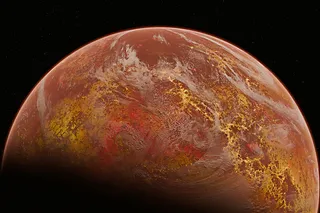
A brown dwarf is an object larger than a planet but smaller than a star; it forms like a star but lacks enough mass to emit starlight.
The data also showed more: the brown dwarf is about 25 Jupiters, and the star is 85 Jupiters.
The two objects are also extremely close from a celestial perspective — the brown dwarf’s orbit is smaller than the diameter of the sun.
A Stream Of Matter
The closeness of the two objects raised another question: could the larger object be drawing material from the smaller?
To find out, the team simulated how particles of matter on the brown dwarf would behave over time. The results suggest the star is indeed extracting matter from its smaller companion (a process known as accretion) — or, in more casual parlance, is snacking on the brown dwarf, albeit very slowly in celestial terms.
According to the team’s estimates, the star pulls in enough matter to fill about 40 million dump trucks every second. At that rate, it could take the star billions of years to polish off the brown dwarf.
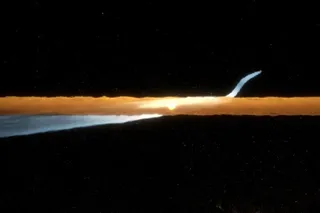
This process would look like a stream of matter flowing from the brown dwarf to the star — “Matter just pummels directly onto the surface, at very high speeds, like an asteroid hitting the moon,” said Burdge.
The stream explains the triangular system, Burdge explained. “It’s like you’ve got this continuous fireball onto one of the objects, and as one orbits the other, that hotspot comes in and out of view, and the peak of the triangle signal is when you are looking right at the fireball.”
Read More: Why Brown Dwarfs May Explain the Main Differences Between Stars and Planets
Article Sources
Our writers at Discovermagazine.com use peer-reviewed studies and high-quality sources for our articles, and our editors review for scientific accuracy and editorial standards. Review the sources used below for this article:
- This article references information from a study published in Nature Astronomy: Stable mass transfer from a substellar object onto an M dwarf”