

The deep sea is, in many ways, very similar to space — both are dark, inhospitable environments and largely underexplored.
Take, for example, the Clarion-Clipperton Zone (CCZ) — a 2.3 square-mile (6 million square-kilometer) section of the central Pacific Ocean that stretches from Hawai’i to Mexico. It is home to an eclectic mix of strange and exotic creatures adapted to deep-sea living, including sea cucumbers, carnivorous sponges, and a group of plant-like invertebrates called crinoids. Yet the vast majority of species inhabiting this region remain unnamed.
In an attempt to rectify the situation, a team of scientists, writing in the journal ZooKeys, has described 24 species of crustaceans for the first time. Amongst the newly named species is a creature that belongs to an entirely new branch of life.
“A new superfamily is very rarely found — even in the deep sea, where finding new species is very common,” co-author Tammy Horton of the National Oceanography Centre (NOC), U.K., told Discover. “It likely won’t happen again in my career.”
Read More: 8,000 Suggestions Later, a Newly Discovered Deep-Sea Species Gets Its Name
Naming 24 New Species
Over the last few decades, hundreds of expeditions to the CCZ have taken thousands of samples. From these samples, more than 5,500 species have been recorded. However, only about 90 percent have been officially named, according to Cell.

 Explore All Options
Many species are instead known by temporary names or codes, which can be highly problematic from a conservation perspective.
According to the study, only species that are formally described can become conservation subjects. Hence, the effort of 16 taxonomists, who attended a workshop at the University of Lodz in Poland, was to name and describe 24 species of amphipods (small crustaceans that resemble shrimp).
The paper is based on dozens of specimens extracted from sediment collected in the CCZ. The team analyzed the crustaceans’ physical characteristics and used DNA barcoding, a technique that uses short DNA segments to identify and differentiate species.
“Providing a formal description and name gives each species a kind of 'passport,' allowing it to be acknowledged, studied, and — when necessary — protected,” co-author Anna Jażdżewska of the University of Lodz told Discover.
Discovering A New Branch Of Life
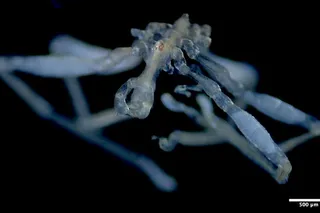
Among the new species is an amphipod named Mirabestia maisie, after Horton’s daughter, Maisie. According to the researchers, it not only belongs to a new species but to an entirely new superfamily — a rank between infraorder and family.
In a separate paper published in Zookeys, Horton and others note differences in its mouthparts, which are conical, the form of its front two legs (gnathopods), and its antennae. This meant it could not be placed into one of three existing superfamilies in the infraorder Hadziida.
The new superfamily has been named Mirabestia — a combination of the Latin words “mira” and “bestia,” meaning “wonderful” and “beast.”
Racing Against The Clock
Conservationists are under intense time pressure to name species in the CCZ as deep-sea miners look to exploit the area, which is littered with manganese nodules. These dark, grey clumps contain high levels of manganese and iron, as well as concentrations of metals essential to battery manufacturing.
Naming the species that inhabit the area can support efforts to understand the potential implications of deep-sea mining and future conservation efforts.
“The deep sea is a vast ecosystem that provides habitat for an enormous number of species,” said Jażdżewska. “Some of them may seem odd to us, but each plays an important role in this environment.”
By formally recognizing 24 new species, the paper more than doubles the number of amphipods living in the CCZ that have been described to date.
Horton told Discover there is still a huge amount to learn about the biodiversity of the deep ocean, but that this effort shows that improving our understanding of these environments is achievable when we work collaboratively and with a shared goal.
The research was carried out as part of the International Seabed Authority’s “One Thousand Reasons” project, which seeks to name and describe 1,000 deep-sea species within a 10-year period.
Read More: 99.999 Percent of the Deep Ocean Is Unexplored — Its Secrets Are Key to Understanding Our Planet
Article Sources
Our writers at Discovermagazine.com use peer-reviewed studies and high-quality sources for our articles, and our editors review for scientific accuracy and editorial standards. Review the sources used below for this article:
- This article references information from a recent study published in Zookeys: New deep-sea Amphipoda from the Clarion-Clipperton Zone: 24 new species described under the Sustainable Seabed Knowledge Initiative: One Thousand Reasons campaign
- This article references information from a study published in Zookeys: A new superfamily and family of the infraorder Hadziida (Amphipoda, Senticaudata) based on a new genus and species from the Clarion-Clipperton Zone, Pacific Ocean
- This article references information from a study published in Cell: How many metazoan species live in the world’s largest mineral exploration region?