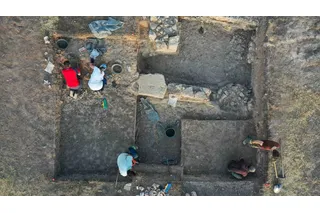
The Mizyn archaeological site in northern Ukraine has revealed secrets of ancient humans for over a century. Mizyn’s central features are the remains of various dwellings made from mammoth bone.
Researchers have now reanalyzed 18 tiny figurines, also made from mammoth ivory, unearthed with the structures. They report in the journal Heritage Science that ancient artists used natural features within the mammoth bone to guide the design of engravings that cover the figurines, which are thought to have been carved during the Stone Age, roughly 18,000 years ago.
Simon Radchenko, an archaeologist at the University of Stavanger and co-author of the new study, told Discover that the new discovery “is impressive evidence of artists engaging with the material they work with both aesthetically and technologically — evidence we are rarely able to receive.”
The study provides archaeologists with more information about how ancient art evolved.
“Our findings challenge the long-held assumption that ancient art simply evolved in a straight line from basic to complex forms,” said Dmytro Kiosak, an archaeologist at the Leibniz Centre for Archaeology and co-author of the new study, in a statement.
Read More: New Ice Age Toad Species Discovered in La Brea Tar Pits Fossil Collection

 Explore All Options
Preserving 18,000-Year-Old Artifacts
Archaeologists first discovered the Mizyn figurines during excavations at the site between 1908 and 1913. They were made by carving chunks of mammoth ivory into figures crisscrossed with markings. The authors wrote that the figures’ complex markings separated them from other ancient carved pieces across Upper Paleolithic Europe (a period between 50,000 and 12,000 years ago).
With Ukraine locked in a years-long war with Russia, the National Museum of the History of Ukraine gave an international research team permission to scan the figurines digitally to preserve them. The scientists also studied the figurines under microscopes to analyze their surfaces in more detail.
"Projects like this not only deepen our understanding of the past but also create new opportunities for research. At a time when war continues to threaten Ukraine's cultural heritage, creating high-quality digital records of artifacts is a crucial step in preserving them," Oleksandr Naumenko, researcher at the National Museum of the History of Ukraine, said in the press release.
Where Mammoths Met Art
The modeling found that the bone carvings followed and recreated the natural lines present in the mammoth ivory. Mammoth ivory contains natural structural features known as Schreger lines and growth increments known as Owen lines. The researchers found that artists incorporated these patterns into the figurines' engravings
“This discovery offers an extraordinary window into how Paleolithic peoples perceived and engaged with their material world,” said Aimée Little, an archaeologist at the University of York and co-author of the new study in the press release.
“Identifying visual evidence of how mammoths were integrated into artistic traditions, both through the use of their ivory and the deliberate inscription of its natural patterns, represents a genuine breakthrough in our understanding of prehistoric art and material culture,” Little said.
Forging Their Own Path
The Mizyn figures appear to be among the first created after a multi-millennia drought during the peak of the last Ice Age in Europe. The researchers said that although figure-making re-emerged across Europe after the glaciers retreated, Mizyn’s artists alone incorporated natural tusk patterns into their carvings.
“When figurine-making re-emerged around 18,000 years ago, it began earlier in Eastern Europe than in the West. While later Western European styles also featured abstracted female forms, none reproduced the internal tusk patterns seen at Mizyn,” Andrew Needham, from the University of York’s Department of Archaeology, said in the press release.
“This indicates that Ice Age artists in Eastern Europe forged their own independent artistic path rather than simply following trends from Western Europe,” Needham concluded.
Article Sources
Our writers at Discovermagazine.com use peer-reviewed studies and high-quality sources for our articles, and our editors review for scientific accuracy and editorial standards. Review the sources used below for this article:
- This article references information from a study published in Heritage Science: Internal structure of Mammoth ivory inspired the design of Mizyn (Ukraine) Upper Palaeolithic figurines