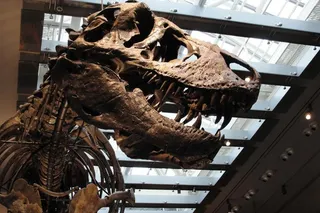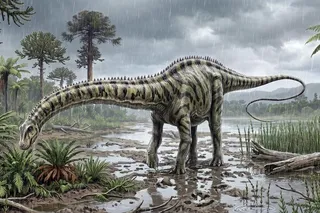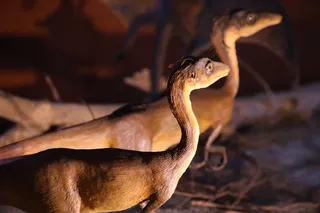


The Jurassic Era ended 145 million years ago. Everything we know about this period has been pieced together from fossils, rocks, and other geological clues. But while bones and fossilized feathers can tell us something about how dinosaurs and other Jurassic-Era animals looked, there is little that can reveal how they sounded. This is because vocal organs rarely preserve well, whether that be a frog’s air sac, a mammal’s larynx, or a dinosaur’s sound box.
There is, however, a notable exception. The sound-producing organs of some insects have survived for hundreds of millions of years. Now, researchers writing in the Proceedings of the National Academy of Sciences have combined information from 20 fossils with data from their twenty-first-century relatives to produce an auditory snapshot of life in the Middle Jurassic.
“Imagine stepping back in time 165 million years to a Jurassic forest. We often picture these ancient landscapes dominated by towering dinosaurs, but what did these ecosystems actually sound like?” co-author Fernando Montealegre-Z, professor of sensory biology at the University of Lincoln, U.K., told Discover.
“Surprisingly, the answer may come not from dinosaur fossils, but from ancient insects.”
Read More: These Amber Fossils Offer a “Snapshot of Life on Earth Millions of Years Ago”

 Explore All Options
From A Single Call To A Chorus
The initial impetus for the idea occurred over a decade ago, in 2012. The team had successfully reconstructed the call of a single Jurassic katydid species, Archaboilus musicus, showing that it is possible to reconstruct insect calls from fossils. However, it left a much bigger question unanswered, co-author Jun-Jie Gu, a professor at Sichuan Agricultural University, China, told Discover. What did an entire Jurassic forest soundscape look like?
“We wanted to move from a single “solo” to a full “chorus,” said Gu. “That required many more fossils from the same time and place, which we eventually found in the Jiulongshan Formation of Daohugou, Inner Mongolia — twenty specimens representing nine species, all from the same geological layer. That's what made the soundscape reconstruction possible.”
Each of the twenty fossils belongs to a species of ensiferan, a suborder of insects that includes crickets, katydids and their allies. These insects boast specialized body parts that make a noise when their wings rub together.
Variations in these structures produce sounds unique to each species, enabling individuals of that species to recognize and communicate with one another.
As such, the structure preserved in the fossil wings serves as a “fingerprint” of the sound-producing system, Montealegre-Z explained. This enabled the team to infer characteristics such as the frequency of vibration and the amplitude of individual syllables. However, that alone did not paint the full picture. This is because the fossils do not preserve behavior.
To explain how those syllables were arranged into songs, the team used artificial intelligence and computational models. These were trained on data collected from living insects before being applied to the Jurassic-Era fossils.
“Hearing the first reconstructed call was fascinating. It revealed that the way these insects produce sound has changed remarkably little since the Jurassic period. But the most extraordinary moment was hearing all the calls together,” said Montealegre-Z.
“These species likely lived side by side, and for the first time we could listen to a soundscape that may have filled Jurassic forests, much like the chorus of chirping insects we hear in tropical rainforests today,” Montealegre-Z added.
The Evolution Of Ultrasonic Communication
As well as highlighting the diversity of calls and songs produced by these ancient critters, the results shed light on the development of ultrasonic communication in insects, suggesting it may have occurred earlier than traditionally thought.
Most of the species studied appear to have produced low-frequency pure tones, and several appear to have songs at higher frequencies of 10 kHz or more, but one produced a call above 20 kHz. If confirmed, this would suggest ultrasonic communication in insects occurred long before the arrival of bats, who first appeared in the Eocene, approximately 55 million years ago.
“It fundamentally challenges the long-standing hypothesis that bats were the primary drivers of ultrasonic communication in insects,” said Gu.
“Instead, our evidence suggests that early mammals or mammalian-like predators, which already had sensitive high-frequency hearing, were likely the ones eavesdropping on these insect calls — turning a mating signal into a potential dinner bell.”
Read More: 113-Million-Year-Old Hell Ant Fossil Breaks Age Record for Such Insects
Article Sources
Our writers at Discovermagazine.com use peer-reviewed studies and high-quality sources for our articles, and our editors review for scientific accuracy and editorial standards. Review the sources used below for this article:
- This article references information from a study published in PNAS: Reconstruction of an extinct soundscape reveals ultrasonic communication in the Jurassic