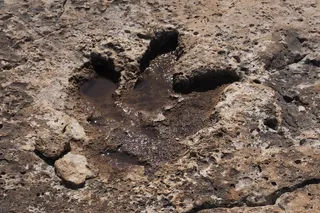
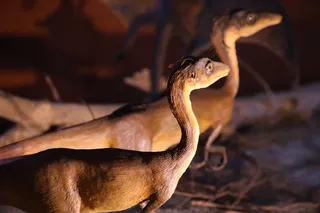
Around 160 million years ago, when the earliest bird-dinosaurs emerged and massive sauropods occupied the land during the Jurassic, a large squid-like cephalopod roamed the ancient sea in an area that is now Wyoming.
Based on two fossilized internal shell structures from animals called belemnites, an international team of researchers has identified a new species and could add another member to a prehistoric cephalopod family thought to be extinct millions of years earlier, as described in Papers in Paleontology.
The experts found those two fossils particularly unusual, as they are the chunkiest belemnites ever found, inspiring researchers to take a closer look at why they stand out compared to other “squid butts,” as that type of fossil is also called.
“After spending years fossil hunting in Wyoming and collecting countless fossils of the common Pachyteuthis belemnites here in Wyoming, this one is unlike anything I have ever seen!” said study co-author Jessica Lippincott, paleontologist with the Wyoming Dinosaurium Project, in a press release. “It goes to show that we are still finding new species of fossils all the time, and people who rockhound or collect invertebrate fossils can also contribute to science.”
Thickest Fossils of their Kind Help Estimate the Size of New Squid-like Cephalopod
Belemnite fossils are not that rare themselves. The bullet-shaped cephalopod remnants can be found around the world, especially on beaches or in ancient marine sediments like the Wyoming Sundance Formation, which used to be an inland marine basin in the western U.S.

 Explore All Options

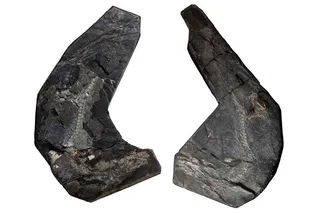
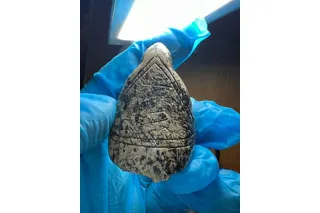
The paratype and holotype specimens of Wyoteuthis linsterorum with a scale bar.
(Image Credit: © Courtesy of Jessica Lippincott)
But the remains of the novel species, Wyoteuthis linsterorum, were different. Measuring 4 inches long and 2.4 inches wide, these belemnites “stuck out like a sore thumb,” according to study co-author William Wahl in the press release. For comparison, belemnites from that area are usually less than an inch wide. Based on the chunky fossils, experts estimated the animal’s total length was around 24 inches, including its arms.
“The find is incredibly rare, which might be due to some ecological adaptations to the environment at the time. Perhaps its rarity is a result of narrow specialization,” said co-author Dean Lomax from the University of Bristol in the release.
A Discovery Unlike Previously Known Belemnites
Using computed tomography (CT) scans, the researchers could examine the internal structure of the fossils and confirm the new species as part of a prehistoric family of marine animals that was believed to have long been extinct.

A Wyoteuthis linsterorum paratype (left) beside a common Pachyteuthis fossil for size comparison.
(Image Credit: © Courtesy of Jessica Lippincott)
This family has been studied extensively, making the discovery of the fossil and naming of a new species a surprising development. Generally, as belemnites have been studied for more than 200 years, according to the study’s first author Alexey Ippolitov from Victoria University of Wellington, New Zealand, adding a new species to the already extensive belemnite record has become very rare.
“A possible explanation is that their relatively large size gave them an advantage when hunting co-occurring smaller belemnites of the genus Pachyteuthis,” explained Ippolitov in the news release. “Modern squid, after all, are hardly picky when it comes to prey: they readily hunt not only other species of cephalopods, but sometimes even their own kind.”
Naming the New Species After a Fossil-Hunting Family
The first of the two chunky belemnites was already found 30 years ago, but despite its unusual size, the fossil was added to the collection of the Wyoming Dinosaur Center without being studied further.

Cliff Linster.
(Image Credit: © Courtesy of the Linster family)
Then a second, similarly sized belemnite fossil was unearthed by fossil collector Cliff Linster and given to the museum in 2019. The fossil pair then inspired the study that later confirmed their status as a new species.
Due to his contribution to the identification of a new species, the late Linster was honored by naming Wyoteuthis linsterorum after him. Wyoteuthis refers to the location where the fossils were found, translating to “a squid from Wyoming." Interestingly, the Linster family has already made a name for themselves by first discovering another famous fossil: the bird-like theropod Bambiraptor. This again shows how important hobby paleontologists' contributions can be.
Read More: 31 New Species Found off Brazil Reveal a Fragile World in the Ocean’s Midwater
Article Sources
Our writers at Discovermagazine.com use peer-reviewed studies and high-quality sources for our articles, and our editors review for scientific accuracy and editorial standards. Review the sources used below for this article:
- This article references information from a new study that was published in Papers in Paleontology: ‘The big chunky belemnite’: a new relict megateuthidid from the Oxfordian (Late Jurassic) of Wyoming, USA, and its place in the evolutionary history of the group