

For roughly 23,000 years, the Bering Land Bridge served as a gateway between the east and west. Countless humans and animals used the passage, now sunken under the waters of the Bering Strait, to travel between Asia and North America. Now, archaeologists digging in interior Alaska have found numerous clues about the peoples who lived there. They’ve published their findings from a site that yielded more than 80,000 buried artifacts dating from around 13,800 years ago.
The dig took place at Shég’ Xdaltth’i’ (pronounced shehg xuh-tuhl-th’ee), which means “they were there” in the Alaskan Native language Athabaskan. The site is roughly 34 miles south-southeast of Fairbanks and lies on the traditional lands of the contemporary Mendas Cha’ag and Nenana communities of Tanana Athabaskan Indigenous peoples. Shég’ Xdaltth’i’ has a commanding view of the surrounding area.
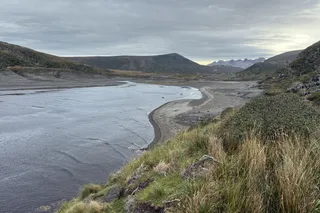
“The site is on a small ridge that overlooks the Tanana River, which is a major river system of the region. Today there are spruce trees all around. During the last part of the Pleistocene — the Ice Age — it was covered by shrub-tundra vegetation,” said Kelly Graf, an anthropologist at the University of Kansas and co-author of the new study published in Science Advances, in a press release.

 Explore All Options
Graf made multiple visits to Shég’ Xdaltth’i’ between 2013 and 2025.
Read More: Homo Erectus Crossed an Ancient Land Bridge to Roam Southeast Asia 140,000 Years Ago
One of The Oldest Dwellings in North America

Steppe bison bone recovered at Shég’ Xdaltth’i’.
(Image Credit: Kelly Graf)
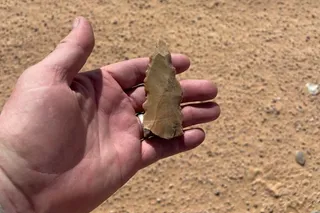
At the site, the team unearthed the remains of an ancient domestic dwelling and a nearby hearth. At nearly 14,000 years old, this site, say the authors, may well be one of the oldest habitations in the Americas. Across the site, the dig yielded artifacts such as bone tools, animal remains, and a series of cut stone artifacts. Some of these rocks are shaped like axe heads; others are ground into diamond shapes. The team refers to them as “hafted bifaces,” as they were likely originally attached to a grip or haft. Graf’s team wants to conduct further microscopic analysis of these bifaces to determine their likely use, but Graf said they were likely used as weapon tips.
Graf said that the distinctive diamond shape of the biface stones was unique to archaeological sites in Alaska. However, researchers have identified tools with similar shapes in eastern Russia.
“It suggests people traveled across the Bering Land Bridge to and possibly from this location,” said Graf.
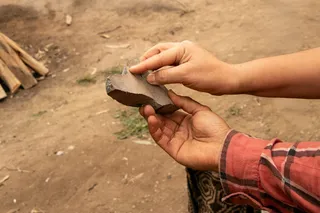
The team also found evidence of the equipment used to make these weapons or other tools from bone or stone, including an ancient stone anvil.
“It was sitting within a dwelling feature, and all around it were really bashed-up bison bones. And there were a lot of quartz and quartzite-rock hammerstones — which were the hammers they used to break the bones. So we think they were using these stones to fully process the bones to extract marrow and likely to render grease,” said Graf.
Lessons from the Past
The fauna samples found at the site were diverse, including musk ox, red fox, eagle, crane, and goose. The peoples who lived at Shég’ Xdaltth’i’ likely used their weapons to hunt large animals, like now-extinct species of horse and bison, as well as woolly mammoths.
“But then they also hunted caribou, which is extant today. Indigenous people in Alaska today hunt caribou. It’s a really important resource for them, and it always has been,” said Graf.
She added that these findings from thousands of years ago still matter in 2026.
“It’s fascinating to me how people have evolved and how our meager beginnings as hunter-gatherers have led to where we are now,” she said. “The past informs us on how humans have adapted and responded to life’s exigencies. The more we learn about the evolution of the Homo sapiens species, the more we can understand ourselves today.”
Read More: Ancient Humans May Have Migrated From Anatolia to Europe on a Long-Lost Land Bridge
Article Sources
Our writers at Discovermagazine.com use peer-reviewed studies and high-quality sources for our articles, and our editors review for scientific accuracy and editorial standards. Review the sources used below for this article:
- This article references information from a study published in Science Advances: Highlights from an early base camp in Beringia 13,800 years ago: Shég’ Xdaltth’í’ and the Late Pleistocene peopling of Alaska