

The last thing geomorphologist Brigid Lynch expected to find while surveying a California creek was a fossilized mastodon tooth.
“As a geologist, I've gone out and seen stuff in the field, but definitely nothing as exciting as this,” Lynch said in a press release.
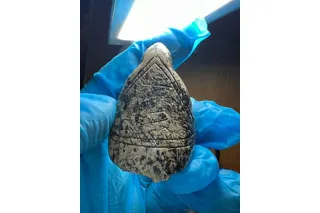
Lynch was working on a Midpen (Midpeninsula Regional Open Space) habitat enrichment program that supports the threatened California red-legged frog when she noticed a strange-looking rock. Upon further inspection, it was actually one of the most intact Pacific mastodon molars to be found in the area.
“The tooth itself is in immaculate condition. It's the most complete mastodon molar from our area, and the most spectacular mastodon molar that I've ever seen. I had chills and shivers up and down my spine,” Wayne Thompson, a paleontologist and owner of Pacific Paleontology, said in the press release. “It's another puzzle in the Ice Age saga that we can put into place.”
What Were Pacific Mastodons?
Pacific mastodons were massive herbivores, similar to the woolly mammoth and modern-day elephants. They lived during the Pleistocene epoch, about 2.5 million to 11,700 years ago, and have only recently been classified as a distinct species apart from the American mastodon. In contrast to American mastodons, Pacific mastodons had narrower teeth, different tusks, and thicker leg bones.

 Explore All Options
Some experts believe Pacific mastodons lived throughout California, Oregon, the Northern Rocky Mountains, and down through parts of the western U.S. and Mexico. Though mastodons were similar to mammoths, they likely had different diets. Mammoths typically fed on grasses while mastodons likely ate a wider variety of foods, including leaves, fruits, or soft shoots from woody plants.
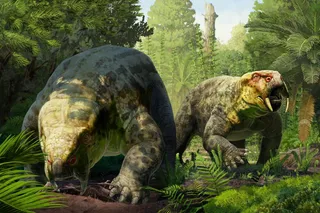
In the region where Lynch found the tooth, common wildlife such as mountain lions and bobcats currently hunt for prey. According to the press release, the ancestors of those animals may have hunted alongside now-extinct animals such as dire wolves or saber-tooth cats. Other animals that may have lived alongside the Pacific mastodon include coyotes, tule elk, American badgers, and Jefferson’s ground sloths.
Read More: Early Americans Got Nearly 98 Percent of Their Calories From Mammoths and Other Large Mammals
Studying the Mastodon Tooth
According to ABC, the tooth is about 8.5 inches long, 3 inches wide, and about 7 inches deep. Paleontologists estimate that it is about 10,000 years old and is in excellent condition.
After its discovery, Midpen donated it to Stanford University’s Doerr School of Sustainability. At the university, research teams hope to determine the tooth’s age more accurately using carbon dating. The team also plans to 3D-scan the tooth to create a model for education and outreach.
“Fossils are our only opportunity to see into past biodiversity,” explained Christine Garcia, curator and manager of the Geoscience Specimen Collection at Stanford, in the press release. “We can study fossils to better understand Earth’s past, past wildlife and the ecosystem they were a part of, and to help us make better predictions and better decisions about how to help our ecosystems and biodiversity thrive into the future.”
This find also highlights the importance of Midpen’s mission to protect wild areas and restore natural environments. You never know what sort of ancient remains are out there.
“This highlights for me that the presence of mastodons wasn't that long ago, in geologic time,” said Midpen biologist Matt Sharp Chaney in the press release. “That mastodons were out here in the same landscape that we’re in today really drives home how important the work that we do is to keep species from winking out forever.”
Read More: Accidental Paleontologists Discover Mastodon Jaw in Backyard Garden
Article Sources
Our writers at Discovermagazine.com use peer-reviewed studies and high-quality sources for our articles, and our editors review for scientific accuracy and editorial standards. Review the sources used below for this article:
- This article references information from Midpen: 10,000-year-old fossilized mastodon tooth discovered in Midpen preserve
- This article references information from ABC: 10,000-year-old fossilized mastodon found in creek