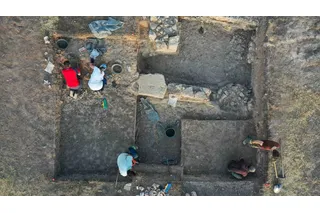
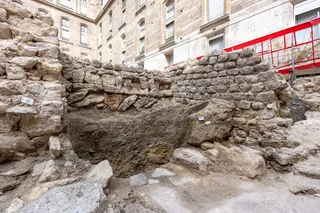
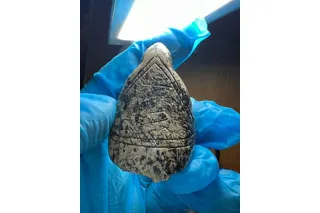
In 2012, archaeologists at Göbeklitepe, in southeastern Türkiye, unearthed a grave in a small room beside one of the site’s great stone enclosures. Because there wasn’t time to excavate it fully, they had to seal it back up. When they reopened it in 2022, the excavation revealed a woman in her 20s who had been laid on her side on a bed of fist-sized stones more than 10,000 years ago.
Her grave is one of the first of two intact burials excavated at Göbeklitepe. The other, found in 2017, held at least three people. For years, the human remains found at the site had mostly been hundreds of scattered, broken bone fragments, some of which researchers linked to ritual. In a study published in PLOS One, Julia Gresky and Lee Clare of the German Archaeological Institute compared the damage on those fragments with the damage on bones from both graves. They suggest that at least some of the fragments came from graves higher on the mound, carried downhill with the soil into the stone enclosures below.
Scattered Bones at Göbeklitepe

(Image Courtesy of J. Gresky, DAI; B. Waszk, DAI; https://doi.org/10.1371/journal.pone.0358979.g003/ CC BY)
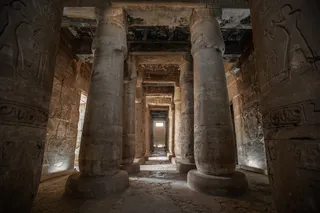
Hunter-gatherers began building at Göbeklitepe about 11,600 years ago, as people began shifting from foraging to farming. For its first two decades of excavation, researchers described Göbeklitepe as a sanctuary built for ceremonies, not for living. More recent work, though, has turned up evidence of houses and everyday activities.

 Explore All Options
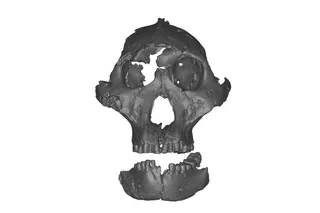
Excavators have also collected 928 fragments of human bone from the dirt and rubble that buried its buildings and the spaces between them. With no graves to compare them against, no one could say where the pieces came from. In 2017, Gresky described skull fragments from three individuals with deep grooves carved along the top and proposed that the site had a skull cult.
That same year, work on a drainage channel for the site’s roof exposed the second grave, dug through a building floor. It held at least three people, including a woman over 35, a man in his 20s, and a girl between 11 and 14. Earlier remains appear to have been shifted aside with each new burial, and the skulls were gathered in one corner.
Read More: 2,000-Year-Old Chinese Rock Art May Have Been Preserved with Blood and Lime
Graves and Loose Bones Show the Same Damage
The young woman’s grave had been left mostly undisturbed, yet her long bones (the bones of her arms and legs) had broken into pieces and were crusted over with minerals. Some also carried what may be rodent tooth marks. Bones from the shared grave and many of the loose fragments showed the same kind of damage, which could have happened after burial.
The young woman’s room sat on a slope above one of the stone enclosures, which lie in a hollow. The study authors think that the building on the slopes made the ground unstable. Heavy rain or earthquakes may have sent it sliding, carrying the buried remains with it into the enclosures.
The fragments turn up across roughly 32,000 square feet and, in places, many feet down, with skull pieces mixed among bones from the rest of the body. If people had placed all those bones in the buildings on purpose, the researchers argue, they would more likely have clustered in particular spots.
Still, the team can’t trace any single loose fragment back to a grave. Even in the young woman’s room, skull fragments found above her in 2012 look like a man's, while her jaw and the rest of her skeleton are a woman's. They may belong to someone else whose remains had mixed into the soil of her room.
Some Skulls Still Point to Ritual
Sliding soil cannot account for the grooves carved into some skull fragments. The grooves now appear on remains from five people, and the skull-cult idea remains a possibility.
At nearby Sefertepe, archaeologists found at least 21 skulls arranged in a small chamber, evidence that people in the region did handle skulls deliberately. Without distinct dates for Göbeklitepe's bones, researchers can't yet tell when its practices took place or whether they overlapped.
The two graves can't answer those questions, but they do show that people at Göbeklitepe buried their dead beneath their floors and, in at least one case, appear to have returned to make room for someone else.
Read More: 1,500 Animal Remains and Tools Suggest Neanderthals Returned to This Spanish Cave for Generations
Article Sources
Our writers at Discovermagazine.com use peer-reviewed studies and high-quality sources for our articles, and our editors review for scientific accuracy and editorial standards. Review the sources used below for this article:
- This article references information from a study published in PLOS One: First burials give insights into mortuary rites at Göbeklitepe, Early Neolithic Türkiye