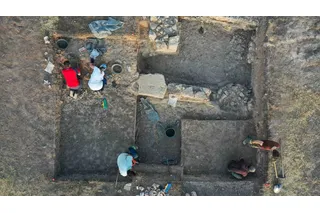
Along a stretch of the Trema River in Cornejo, northern Spain, children and adults gather to sort through dirt from a cave. This year, about 50 volunteers washed and sieved roughly half a metric ton of sediment from Prado Vargas, recovering the remains of voles and other small rodents.
Their finds will help researchers reconstruct the climate and landscape around a cave where Neanderthals once prepared food and worked on stone tools. At the site itself, this summer’s excavation recovered more than 1,500 animal remains and tools from a layer dating to around 46,000 years ago.
Researchers think Prado Vargas served as a large Neanderthal camp, where groups made seasonal stays between spring and late autumn over several generations, according to a press release from Spain’s National Research Center for Human Evolution (CENIEH).
Read More: Some People Carry a Neanderthal Growth Hormone Receptor That Is Linked to Greater Muscle Mass
Excavating a Neanderthal Camp in Spain
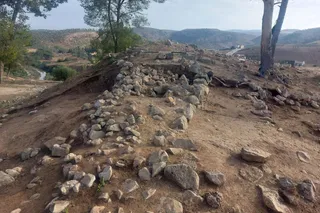
Prado Vargas forms part of the Ojo Guareña cave complex in northern Burgos province. About 20 archaeologists and students worked near the entrance this summer, opening another 344 square feet (32 square meters) of the Neanderthal deposit known as sublevel 4D.
The team has now uncovered 1506 square feet (140 square meters) of that layer, an area that puts Prado Vargas among the world’s largest Neanderthal cave excavations, according to CENIEH.

 Explore All Options
Among the animal remains were teeth and bone fragments from horses, wild boar, steppe bison, aurochs, and red and fallow deer. Neanderthals left cuts and impact marks on many of these bones, especially those from the limbs, as they butchered carcasses and cracked long bones open for marrow.
Animal Bones Helped Keep Stone Tools in Use
Neanderthals used fragments of animal long bones, the elongated bones found in the limbs, to touch up the edges of their stone tools. Archaeologists call these bone implements retouchers, and the team found several more this summer.
The latest finds bring the site’s collection to around 100 retouchers, giving them many examples of the bone tools Neanderthals used to work stone. Researchers consider the collection particularly useful for studying this technique. The bones preserve evidence of how people maintained their equipment, alongside the marks left by preparing animal carcasses for food.
Flint accounts for about 95 percent of the stone tools recovered this season, with quartzite and quartz making up the rest. Sharp flakes that had not been shaped further were the most common finds, followed by scrapers and pieces with notched or toothlike edges.
Homo Sapiens Used the Cave After Neanderthals
Archaeologists uncovered a hearth at Prado Vargas in 2025 that was left by Homo sapiens thousands of years after Neanderthals had used the cave. The team finished excavating the younger Upper Paleolithic layers containing the hearth this summer.
The hearth has a preliminary date of about 35,000 years ago. It is associated with some of the earliest Homo sapiens groups known to have lived in this part of inland Iberia.
The younger finds come from a time when some Homo sapiens were spreading through western Eurasia. Studying them will help researchers understand how these early groups used Ojo Guareña and the land around the Trema River.
Read More: A 55,000-Year-Old Skeleton Suggests that Neanderthal Babies Grew Faster Than Human Infants
Article Sources
Our writers at Discovermagazine.com use peer-reviewed studies and high-quality sources for our articles, and our editors review for scientific accuracy and editorial standards. Review the sources used below for this article:
- This article references information from CENIEH: Excavations at Prado Vargas now span 140 square metres of a Neanderthal layer